
Apartment
The Queensbridge Building
Mitsubishi Electric City Multi water cooled heat recovery VRF provides 3.0 MW of integrated heating, cooling and ventilation for high-density mixed-use Queensbridge Building in Southbank.

Mitsubishi Electric Climaveneta Multi Function 4-pipe units deliver quiet, energy-efficient heating and cooling with energy recovery for the adaptive reuse of Sydney’s Sirius Building.

Originally constructed in the late 1970s to provide social housing, the Sirius Building is a distinctive example of Brutalist architecture overlooking Sydney’s Circular Quay. Its transformation into a collection of premium residences and retail spaces represents a significant adaptive reuse project—balancing architectural heritage with the demands of contemporary urban living.
From a building services perspective, the project required a central plant solution capable of delivering heating and cooling to 76 apartments, shared amenities, and retail zones—often simultaneously. Acoustic performance was critical in a residential setting, and proximity to Sydney Harbour meant that all mechanical systems had to be corrosion-resistant. The project also strongly emphasised energy performance, long-term reliability, and future regulatory alignment.

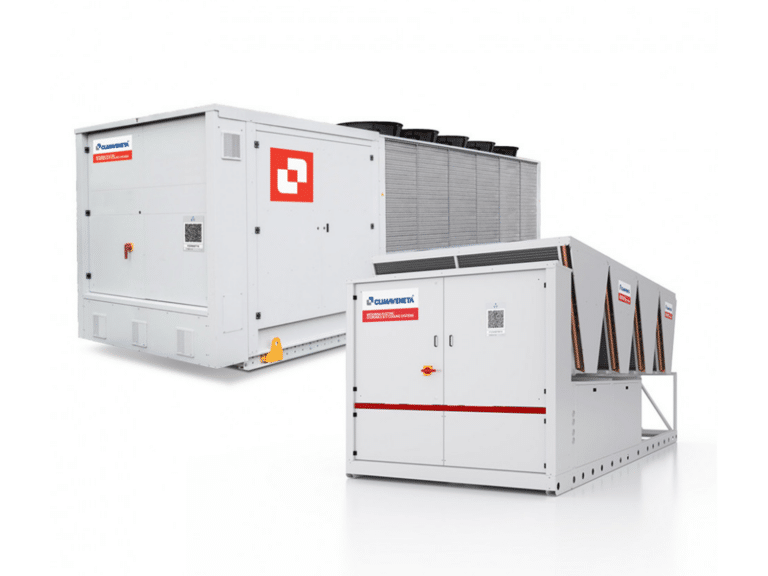
Mitsubishi Electric supplied two Climaveneta NX2-Q-G06 /SL 0404 air-sourced scroll 4-pipe units to serve the building’s central chilled water and heating hot water plant. These units were selected for their ability to deliver simultaneous and independent cooling and heating. They are ideal for mixed-mode environments like Sirius where thermal demands vary from zone to zone.
Key Technical Features and Benefits:
The 4-pipe configuration allows the units to extract energy from one zone and repurpose it in another. This energy recovery process enables free heating during cooling mode and vice versa, significantly improving operational efficiency across seasons. The result is a high Total Energy Ratio (TER), which reflects the system’s ability to deliver thermal energy with minimal input power.
The SL version includes enhanced acoustic insulation and low-noise components, while the Night Mode feature provides an additional 2–3 dB(A) reduction during low-load periods—essential in a residential setting where quiet operation is expected.
Electronically Commutated fans deliver precise airflow control and enhanced performance under partial load, supporting lower energy consumption and maintaining system responsiveness across variable conditions.
The system is designed with lead-lag sequencing, allowing the two units to alternate role as the primary plant while the other remains in standby mode. The standby unit automatically engages when the lead unit alone cannot meet the cooling demand, promoting balanced wear and extending the operational life of both units. This configuration also ensures that one unit is always available to take over in the event of a fault or during maintenance, providing approximately 50% redundancy without requiring oversized equipment.
Silver Fin Guard coating on the condenser coils delivers over 3000 hours of salt spray resistance per ASTM B117, ensuring long-term durability in coastal environments like The Rocks.
The use of R454B, a low Global Warming Potential (GWP of 466) refrigerant, aligns with global environmental standards and future-proofing the system against upcoming regulatory changes. This supports residential projects aiming to meet or exceed sustainability targets, such as Green Star or NABERS ratings.
The system is decoupled into a primary-secondary loop configuration, separating the production of chilled and hot water from its distribution. This allows the central plant to operate independently of fluctuating demand across the building’s zones, enabling more stable water temperatures and smoother equipment operation. The approach improves energy efficiency by reducing unnecessary cycling. It enhances occupant comfort through more responsive temperature control, which is particularly important in high-end residential settings with varied usage patterns across apartments, lobbies, and shared areas.
Adaptive defrost algorithms adjust to real-time ambient and load conditions, minimising unnecessary heat loss. Independent cycle control across circuits ensures continuous heating even during defrost events.

Commissioned in March 2024, the new HVAC system delivers year-round thermal comfort across the Sirius Building, matching the expectations of modern luxury living within a preserved heritage shell. Residents benefit from independent zone control, ultra-quiet performance, and consistent indoor conditions, no matter the weather or time of day.
By incorporating energy recovery, free heating during cooling, and a high TER, the system enables efficient thermal exchange between zones, significantly reducing energy use and supporting sustainability targets such as Green Star or NABERS. The robust marine-grade construction and built-in redundancy ensure the plant is ready for compliance and future operational reliability.
The Sirius Building is a compelling example of how advanced HVAC solutions can elevate an adaptive reuse project, bridging heritage character with future-focused building performance.
Climaveneta Chillers
Apartment
Mitsubishi Electric City Multi water cooled heat recovery VRF provides 3.0 MW of integrated heating, cooling and ventilation for high-density mixed-use Queensbridge Building in Southbank.
Office
Mitsubishi Electric City Multi 2-pipe Heat Recovery VRF delivers simultaneous heating and cooling with centralised control for the St Kilda Road Towers HVAC upgrade.
Apartment
Mitsubishi Electric City Multi Hybrid VRF enables staged delivery and heat recovery comfort for The Yarra build-to-rent development.