Apartment
The Queensbridge Building
Mitsubishi Electric City Multi water cooled heat recovery VRF provides 3.0 MW of integrated heating, cooling and ventilation for high-density mixed-use Queensbridge Building in Southbank.

Mitsubishi Electric City Multi 2-pipe Heat Recovery VRF delivers simultaneous heating and cooling with centralised control for the St Kilda Road Towers HVAC upgrade.
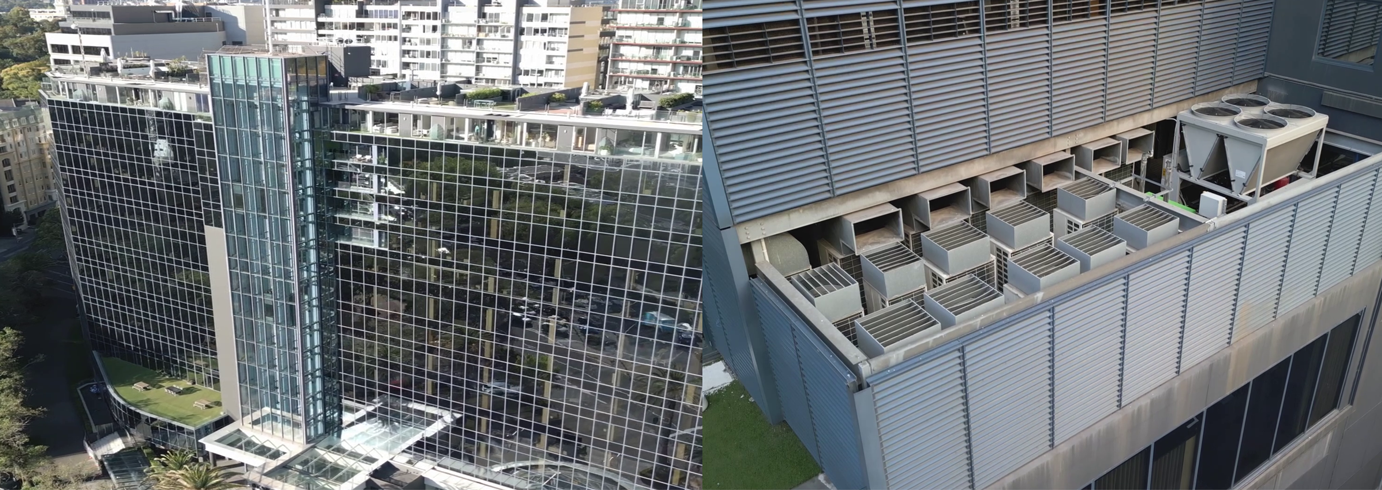
St Kilda Road Towers at 1 Queens Road is a multi-level commercial office building comprising retail tenancies at ground level and 13 levels of boutique office suites above. Constructed approximately 20 years ago, the building’s original air conditioning infrastructure had reached the end of its economic life.
Frequent system failures, increasing maintenance demands, and difficulty sourcing replacement parts had created operational risk for both tenants and building management.
In addition, the outside air fan filter units and toilet exhaust systems had also reached the end of their service life, requiring coordinated replacement to avoid staged disruptions in future years.
The upgrade presented several key challenges:
The Owners Corporation required a solution to restore long-term reliability, improve tenant comfort, modernise controls, and deliver energy-efficient operation. All while minimising disruption to daily building operations.

To address ageing infrastructure and operational instability, a full mechanical services upgrade was undertaken across Levels 1 to 14 (excluding Level 13), replacing the existing VRF system, outside-air fan filter units, and toilet exhaust systems as part of a coordinated program of works.
The selected solution was a Mitsubishi Electric City Multi air cooled 2-pipe Heat Recovery VRF system, designed to provide simultaneous heating and cooling across multiple tenancies with varying load demands.
To support more than 600 office suites across the building, the following equipment was installed:
The 2-pipe Heat Recovery design was selected to reduce refrigerant pipework complexity compared with traditional 3-pipe systems, simplifying riser space requirements and enabling energy transfer between zones during simultaneous heating and cooling.
Each tenancy now has independent local control via a proprietary wall controller, allowing occupants to adjust temperature setpoints and fan speeds within their suite. Centralised monitoring and control are delivered through the Mitsubishi Electric central control platform, providing facility management with system visibility and scheduling capabilities from a single location.
The central controllers include an integrated energy monitoring function that can be enabled via PIN activation and supported by additional monitoring components. Once configured, the system calculates the power consumption of connected air-conditioning equipment, allowing energy usage to be reviewed and compared with previous periods, and to be exported via a LAN connection for reporting and analysis using designated Mitsubishi Electric tools.
The upgrade was delivered in a staged approach, with works carefully programmed to allow tenant relocation floor by floor while maintaining overall building operations.tenant relocation floor by floor while maintaining overall building operations.
‘With over 600 indoor fan coil units, 60 condensers, 14 outside air fans, 42 smoke spill fans and six stair pressurisation fans, all of it was installed in a live environment.’ — Dan Cahir, Project Manager, Bourke Air
The St Kilda Road Towers HVAC upgrade has delivered a modernised mechanical services platform, bringing the building’s HVAC infrastructure into line with current operational and compliance standards.
Since staged handovers began, the Mitsubishi Electric City Multi 2-pipe Heat Recovery system has operated seamlessly across more than 600 office suites. The system provides simultaneous heating and cooling to meet varying tenancy loads, an essential capability in a building with over 700 occupants and diverse operating hours.
A revised control strategy has been central to operational improvements. Rather than a rigid start–stop schedule, the building now operates on a “push-to-start” model with an automatic OFF command at 6 pm. After-hours operation is managed locally within each tenancy via wall controllers, allowing limited extended runtime where required. This approach provides flexibility for tenants, reduces unnecessary whole-floor operation, and delivers immediate energy savings through improved scheduling control.
Each suite now benefits from independent temperature, mode and fan speed adjustment, resulting in improved comfort and more consistent conditions throughout the building. Tenant feedback following the staged upgrade has been positive, particularly regarding temperature stability and overall air quality.
From a facilities management perspective, the centralised control platform provides real-time system visibility, fault coding with timeline tracking, and network-level access to performance data. This has streamlined monitoring, accelerated fault diagnosis and improved responsiveness.
The coordinated replacement of the VRF system reduced the risk of staggered mechanical failures and avoided future disruption.
The result is a reliable, controllable and scalable HVAC solution that complies with current NCC requirements and supports the long-term performance of a high-occupancy commercial office environment.
Heat Recovery
City Multi VRF Air Conditioning Systems
Ceiling Concealed
Centralised Air Conditioning Controllers
Air Conditioning Wall Controllers
Apartment
Mitsubishi Electric City Multi water cooled heat recovery VRF provides 3.0 MW of integrated heating, cooling and ventilation for high-density mixed-use Queensbridge Building in Southbank.
Apartment
Mitsubishi Electric City Multi Hybrid VRF enables staged delivery and heat recovery comfort for The Yarra build-to-rent development.
Medical
Heat recovery CITY MULTI VRF system utilising M-NET for individual tenancy controlled heating and cooling and indoor unit power isolation for staged tenancy fit out.